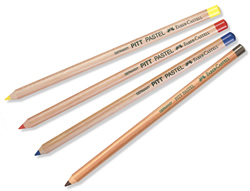
Essentially a traditional soft pastel with a wooden casing for less mess and greater control
Colour matched to all other Faber Castell ranges - this is great if you want to use several different types of pencil in a single sketch but you want to ensure colour matches.
Pastel is naturally watersoluble so add a little water for further blending or to create different effects.
Very compact lead which is economical to use
The colour selection in this 60 colour range is chosen from muted shades and earths which lend themselves particularly well to pastel drawing.
lead is SV bonded (securely gluing the lead to the wood on both sides down the full length of the pencil) this helps prevent breakage and allows for better sharpening to produce a fine point.
High quality pigments with high levels of lightfastness across the whole range
Top tips from Faber Castell when using Pitt Pastel Pencils
Pitt pastel pencils are ideal for drawing lines and shading surfaces, as well as for small pastel drawings and picture details.
Pitt pastel pencils can be smudged by fingers, and thus require light fixing.
Examples of use:
Variations in colour intensity The level of pressure exerted will determine the amount of pigmentation the pastel pencils deposit onto the paper. The artist has a wide range of possibilities, from delicate, fine lines through to impulsive splashes of colour.
Blending colours This blending technique involves working the lighter colour into the darker one, thereby immediately creating a new shade. The lines merge and become very diffuse, and can disappear entirely if coloured over repeatedly.
Blending colours Adjacent areas of colour can be transformed into powerful mixtures of colour when smudged with a finger. The lines remain visible.
Intensifying Whole areas of colour can be created using individual dabs of colour, which can be gently merged by rubbing them softly with the palm of your hand. Different nuances of expression can be achieved in this way.
Transitions Adjacent lines or areas of colour can easily be smudged with a finger to create a distinct block or a delicate transition of colour. The more often the area is coloured over, the greater the intensity of the colour.
Brush painting To create even areas of colour, paint over the strokes made with Pitt pastel pencils using a bristle brush and paraffin oil (baby oil or salad oil).
Corrections Pastel colours can be completely removed from smooth, firm types of paper using a vinyl eraser. Dabbing with an art eraser will lighten the colours.
Fixing Every fixing process alters the vividness of pastel colours. Pitt pastel pencils adhere well to the structure of the paper, meaning that only minimal fixing with a fixing spray is required.